
Category: Seminar

The global conveyor: How river corridor connectivity shapes water quality
October 2, 2026Jesus D. Gomez-Velez, Ph.D., Associate Professor, IIHR-Hydroscience and Engineering, Department of Civil & Environmental Engineering, University of Iowa Join us for the livestream on December 2, 2026 at 11:45 a.m. ET: UF Howard T. Odum Center for Wetlands – YouTube Abstract Transport, storage, and reactions along the river corridor influence mass and energy balances from […]
Read more: The global conveyor: How river corridor connectivity shapes water quality »
Reconstructing past sea-level changes using fossil corals
September 30, 2026Oana Dumitru, Ph.D., Assistant Professor, Department of Geological Sciences, University of Florida Join us for the livestream on November 18 at 11:45 a.m. ET: UF Howard T. Odum Center for Wetlands – YouTube Abstract Future sea-level rise poses major threats to coastal ecosystems, communities, and infrastructure, but projections remain uncertain because we do not yet […]
Read more: Reconstructing past sea-level changes using fossil corals »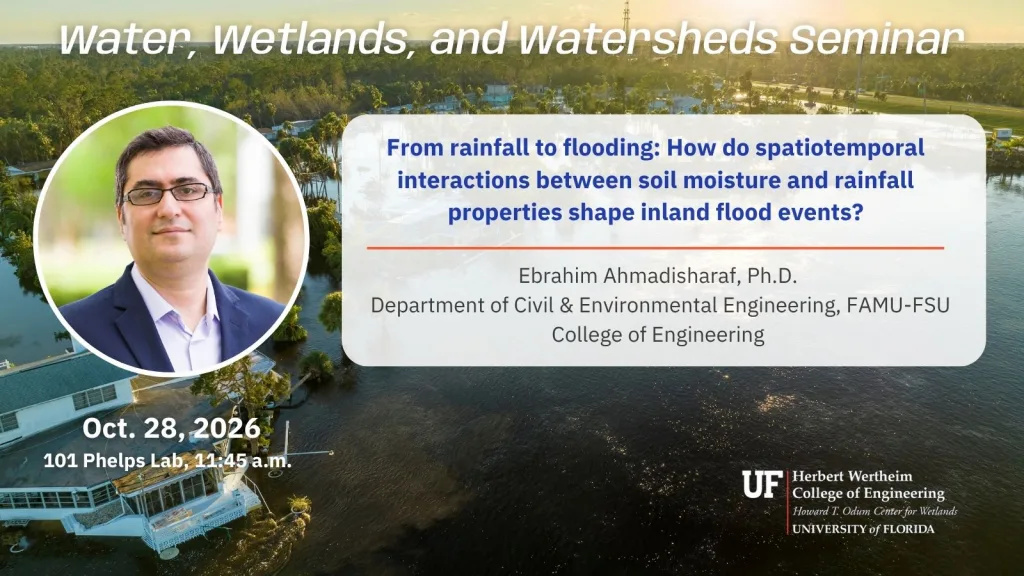
From rainfall to flooding: How do spatiotemporal interactions between soil moisture and rainfall properties shape inland flood events?
September 24, 2026Ebrahim Ahmadisharaf, Ph.D., Department of Civil & Environmental Engineering, Resilient Infrastructure and Disaster Response Center, FAMU-FSU College of Engineering, Florida State University Join us for the livestream Oct. 28, 11:45 a.m., ET: UF Howard T. Odum Center for Wetlands – YouTube Abstract Inland floods have caused substantial damage and loss of life. Recent examples in […]
Read more: From rainfall to flooding: How do spatiotemporal interactions between soil moisture and rainfall properties shape inland flood events? »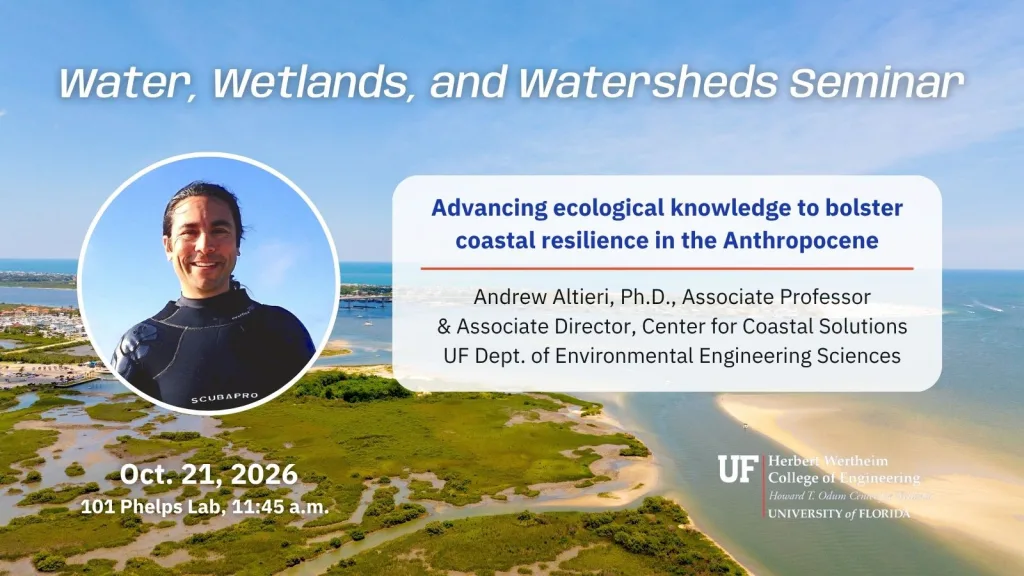
Advancing ecological knowledge to bolster coastal resilience in the Anthropocene
September 24, 2026Andrew Altieri, Ph.D., Scott and Lindy Hearne Rising Star Associate Professor, Associate Director, Center for Coastal Solutions, Department of Environmental Engineering Sciences, Engineering School of Sustainable Infrastructure & Environment Join us for the livestream Oct. 21, 11:45 a.m., ET: UF Howard T. Odum Center for Wetlands – YouTube Abstract Andrew Altieri, Ph.D., will present vignettes […]
Read more: Advancing ecological knowledge to bolster coastal resilience in the Anthropocene »
Sediment composition and geotechnical characterization of a tidal mudflat in Cedar Key, Florida
September 24, 2026Sophia Mercurio, Ph.D., Research Scientist, UF Engineering School of Sustainable Infrastructure & Environment (ESSIE)Herbert Wertheim College of Engineering Join us for the livestream Oct. 14, 11:45 a.m. ET: UF Howard T. Odum Center for Wetlands – YouTube AbstractMud-dominated tidal flats are present around the world; yet, the geotechnical properties that determine their trafficability are not […]
Read more: Sediment composition and geotechnical characterization of a tidal mudflat in Cedar Key, Florida »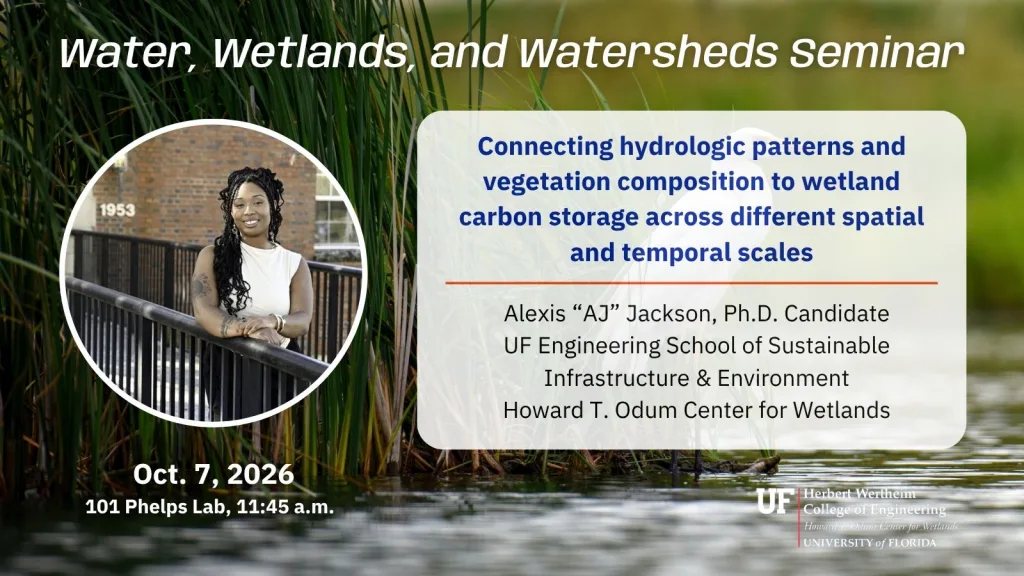
Connecting hydrologic patterns and vegetation composition to wetland carbon storage across different spatial and temporal scales
September 24, 2026Alexis “AJ” Jackson, Doctoral Candidate, UF Engineering School of Sustainable Infrastructure & Environment, Howard T. Odum Center for Wetlands Join us for the livestream Oct. 7, 11:45 a.m., ET: UF Howard T. Odum Center for Wetlands – YouTube Abstract Wetlands are among the most important ecosystems for long-term carbon storage, yet the environmental controls on […]
Read more: Connecting hydrologic patterns and vegetation composition to wetland carbon storage across different spatial and temporal scales »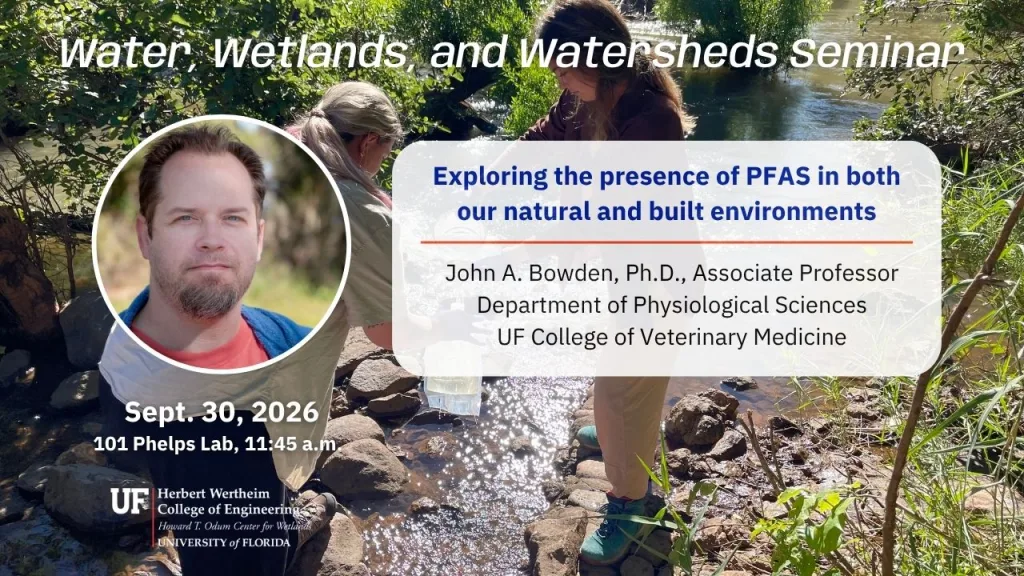
Exploring the presence of PFAS in both our natural and built environments
September 16, 2026John A. Bowden, Ph.D., Associate Professor, Department of Physiological Sciences, UF College of Veterinary Medicine Join us for the livestream Sept. 23, 11:45 a.m., ET: UF Howard T. Odum Center for Wetlands – YouTube Abstract Per- and polyfluoroalkyl substances (PFAS) are synthetic chemicals that have been shown to be ubiquitous, persistent, bioaccumulative, mobile, and there […]
Read more: Exploring the presence of PFAS in both our natural and built environments »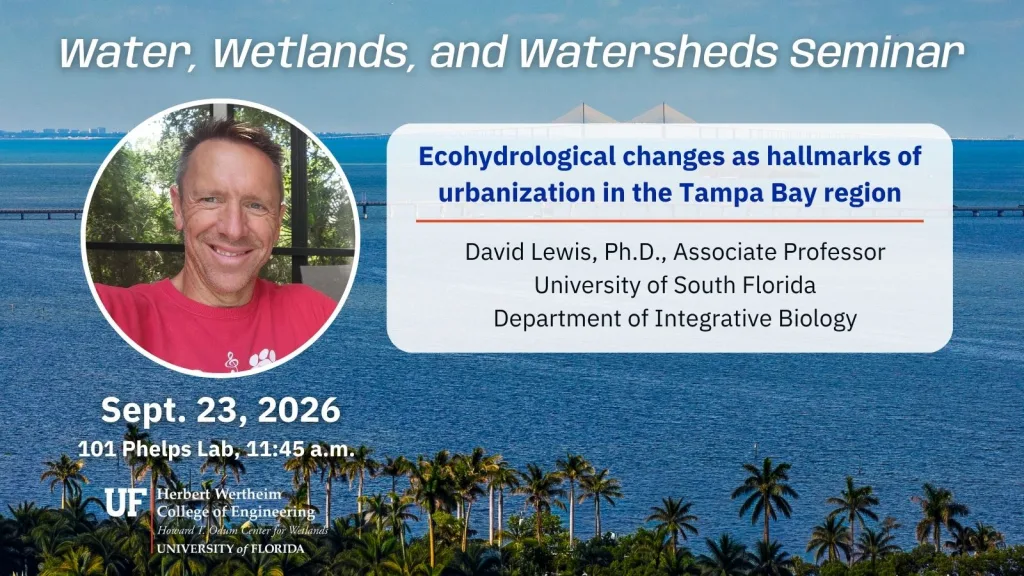
Ecohydrological changes as hallmarks of urbanization in the Tampa Bay region
September 10, 2026Presented by David Lewis, Ph.D., Associate Professor, University of South Florida, Department of Integrative Biology Join us for the livestream Sept. 23, 11:45 a.m., ET: UF Howard T. Odum Center for Wetlands – YouTube Abstract Growth of the global human population has increased the size and resource demands of urban ecosystems. Urbanization is noteworthy in […]
Read more: Ecohydrological changes as hallmarks of urbanization in the Tampa Bay region »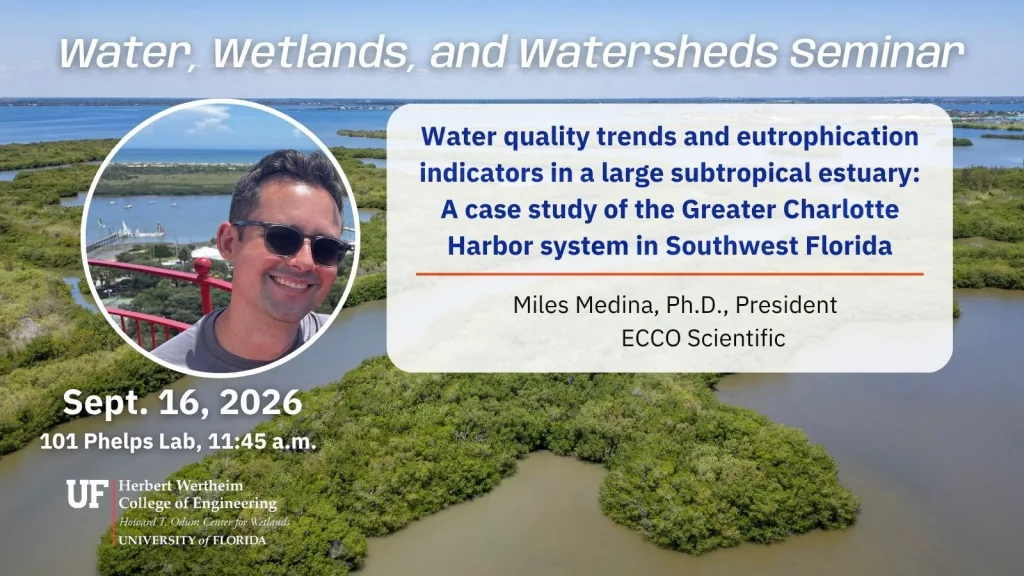
Water quality trends and eutrophication indicators in a large subtropical estuary: A case study of the Greater Charlotte Harbor system in Southwest Florida
September 8, 2026Presented by Miles Medina, Ph.D., President, ECCO Scientific Join us for the livestream Sept. 16, 11:45 a.m., ET: UF Howard T. Odum Center for Wetlands – YouTube Abstract Tracking symptoms of eutrophication over time with multiple lines of evidence provides critical information to support environmental management and restoration efforts. For this case study of the […]
Read more: Water quality trends and eutrophication indicators in a large subtropical estuary: A case study of the Greater Charlotte Harbor system in Southwest Florida »
Understanding the Changing Water Cycle and Water Crises in the Anthropocene: Human and climate threats to global lakes and implications for ecosystems and societies
September 2, 2026Fangfang Yao, Ph.D., Assistant Professor, School of Geosciences, University of South Florida Join us for the livestream Sept. 9, 11:45 a.m., ET: UF Howard T. Odum Center for Wetlands – YouTube Abstract One of the most pronounced human impacts on Earth is the alteration of the hydrological cycle and the associated changes in freshwater availability […]
Read more: Understanding the Changing Water Cycle and Water Crises in the Anthropocene: Human and climate threats to global lakes and implications for ecosystems and societies »