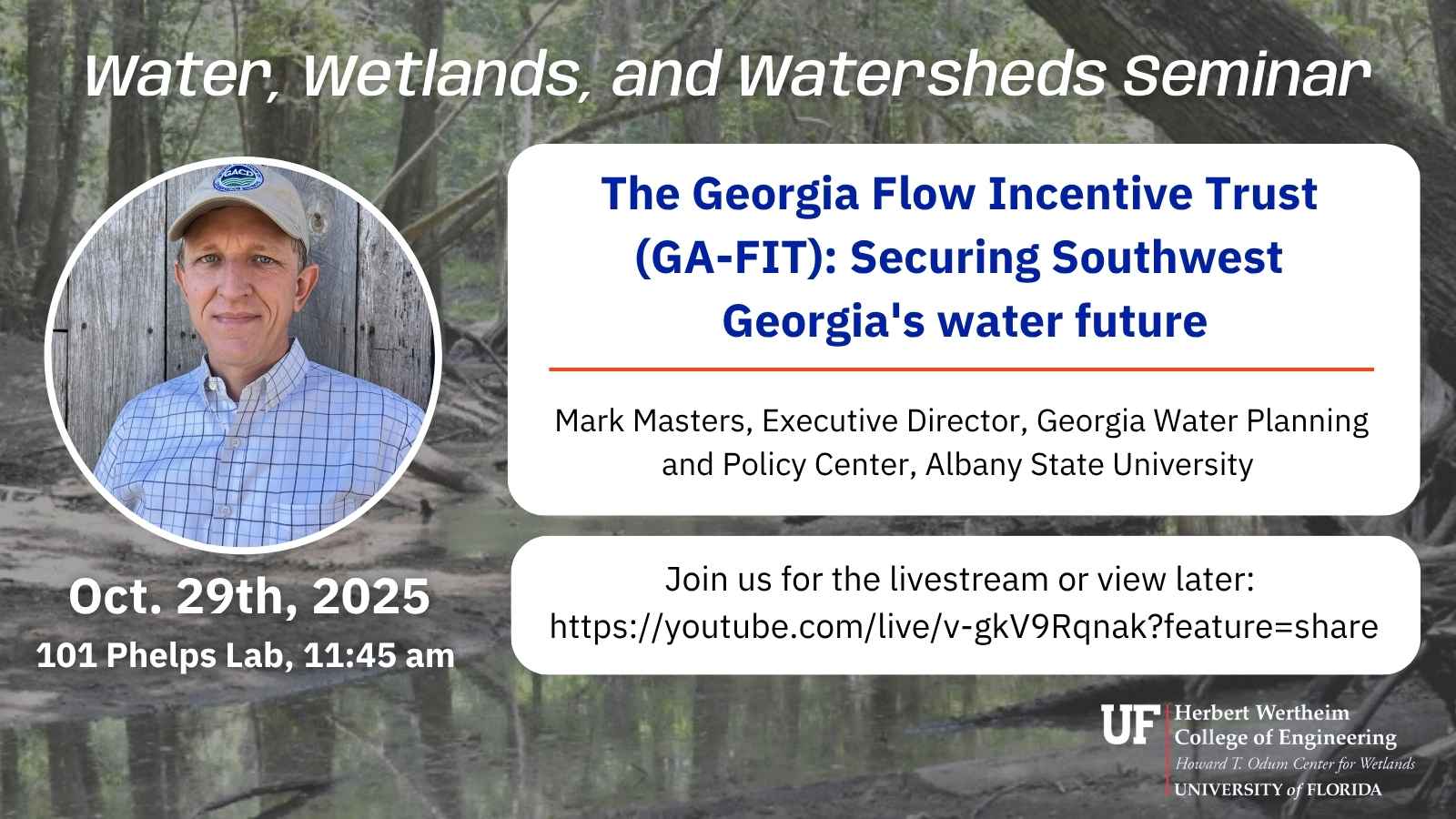
Mark Masters, Executive Director, Georgia Water Planning and Policy Center, Albany State University
Join us for the livestream October 29th, 11:45am ET: https://youtube.com/live/v-gkV9Rqnak?feature=share
(Please visit our YouTube channel main page for the stream if there are any issues with the direct link.)
ABSTRACT
In Southwest Georgia, the Flint River Basin and the region’s aquifers sustain unique natural systems and a robust agricultural economy. However, in some years, drought has caused water scarcity, reducing stream flows and aquifer storage, and created threatening conditions for the farm economy as well as the region’s rare aquatic species. During recent droughts, flows in the Flint River Basin have dropped to low levels and threatened the availability of water for aquatic habitat and other users. The Georgia Flow Incentive Trust (GA-FIT) is a project that seeks to restore flows for aquatic habitats while addressing water security for farmers in the region. GA-FIT is developing new deep aquifer wells to provide alternative water supplies during drought for irrigators that rely on surface water supplies. It is also improving flow augmentation capacity near assemblages of rare freshwater mussels. The project also developed a Habitat Conservation Plan for endangered and threatened freshwater mussels in the region. The project includes a strong stakeholder engagement component to guide implementation. GA-FIT is funded by the Robert W. Woodruff Foundation and a grant from the Governor’s Office of Planning and Budget via allocations established from the American Recovery Plan Act for infrastructure development. This presentation will describe how research, data collection, and stakeholder engagement in research and planning have provided the foundation and stimulus for GA-FIT. It will explain how projects such as the USDA-funded Floridan Aquifer Collaborative Engagement for Sustainability (FACETS) have provided actionable findings and engaged regional stakeholders in collaborative efforts to improve flows and drought response in the region.
BIO
Mark Masters serves as Executive Director of the Georgia Water Planning and Policy Center at Albany State University. He is well-versed on issues related to water use and management and has led or contributed to a large portfolio of conservation research and outreach projects across the United States. Over the past twenty years, he has helped position the Water Center as a trusted resource, not only for the state, but, importantly, for the diverse stakeholders across Georgia that are working to secure the state’s water future. Mark is a nationally recognized leader in agricultural water use and policy and currently chairs efforts focused on water management for the American Farm Bureau, National Association of Conservation Districts and the Interstate Council on Water Policy. He also serves as Outreach Director for the Center for Behavioral and Experimental Agri-Environmental Research, a USDA Center of Excellence focused on applying behavioral insights and experimentation to improve programs related to agriculture and the environment. As a founder and Executive Manager of the ACF Stakeholders, Inc, he was instrumental in helping the group reach consensus on a Sustainable Water Management Plan for the Apalachicola-Chattahoochee-Flint Basin. When he’s not busy professionally, Mark stays out of trouble raising beef on their family farm in southwest Georgia and, along with his wife Amy, enjoys watching their three beautiful daughters make other kids look foolish on the soccer field.
POSTCARD