Joey Smith, Ph.D., Research Scientist, Department of Food, Agricultural and Biological Engineering, The Ohio State University
Join us for the livestream September 17th, 11:45am ET: https://youtube.com/live/jjstVRCgAKM?feature=share
(Please visit our YouTube channel main page for the stream if there are any issues with the direct link.)
ABSTRACT
“I’m swamped!” Wetlands in Ohio were drained for the same reason wetlands carry a negative connotation in the English language: westward expansion. The Great Black Swamp was a large, glacially fed wetland in northwest Ohio that was drained and converted to agricultural land. The destruction of the Great Black Swamp, which filtered nutrients from runoff, contributed to the harmful algal blooms in and the eutrophication of Lake Erie. Today, wetlands and green infrastructure (GI) are being adopted on large scales in Ohio to combat ongoing nutrient pollution and eutrophication problems throughout the state. This presentation quantifies the hydrology and water quality efficacy of two such projects.
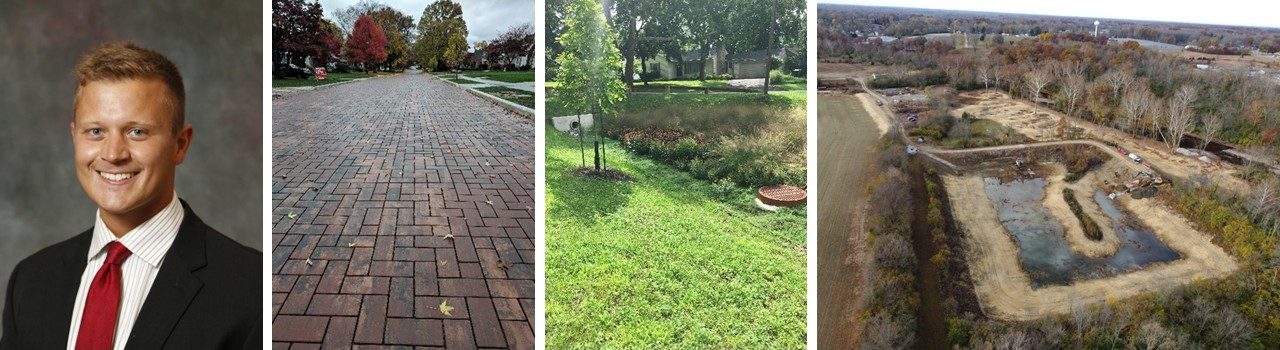
Williamsburg Wetland — In response to recurring harmful algal blooms in Harsha Lake, Clermont County, Ohio, a riparian wetland was constructed in the floodplain of the East Fork Little Miami River, which drains to Harsha Lake and ultimately the Ohio River. The 4-ha constructed wetland system consists of three contiguous treatment zones: a wintering pool (forebay); a 3-acre detention basin (repurposed from a retired drinking water reservoir); and a 7-acre highly sinuous wetland. For the overall system, statistically significant (n = 8, p ≤ 0.05) pollutant load retention was: 93% TSS; 64% total phosphorus (TP); 47% total nitrogen (TN).
Blueprint Columbus — The City of Columbus, Ohio began retrofitting GI into existing development through a multi-decade project in response to a sanitary sewer overflow consent decree. Primary design goals were reducing TSS loads in runoff by 20% and stormwater infiltration and inflow to the sanitary sewer. Through this paired watershed study, nutrients, sediment, and heavy metal reductions were observed in an 11.5-ha watershed where three online bioretention cells treated 66.5% of the imperviousness. TN, TP, and TSS event mean concentrations (EMCs) decreased by 13.7–24.1%, 20.9–47.4%, and 61.6–67.7%, respectively. Runoff attenuation by GI contributed to pollutant load reductions of 24.0–25.4% (TN), 27.8–32.6% (TP), and 59.5–78.3% (TSS). Reductions in TSS concentration were similar (within a margin of 5%) to the percent of the watershed imperviousness treated by GI. GI also contributed to modest heavy metal reductions at the watershed scale.
BIO
Joey Smith is a Research Scientist in the Department of Food, Agricultural and Biological Engineering (FABE) at The Ohio State University. With a PhD in interdisciplinary environmental science, dual BS/MS degrees in FABE, and a BA/MA in Mandarin Chinese – all from OSU – Joey brings a uniquely cross-cultural and systems-level perspective to ecological engineering. His work blends watershed-scale monitoring with community-based approaches to stormwater management, aiming to make green infrastructure more effective and inclusive. Joey has conducted research focusing on “sponge cities” and streetside bioretention as a visiting scholar at Wuhan University in China and Luleå University of Technology in Sweden. His current research centers on tracking the hydrologic performance and water quality benefits of large-scale green infrastructure and wetland projects across Ohio.
POSTCARD