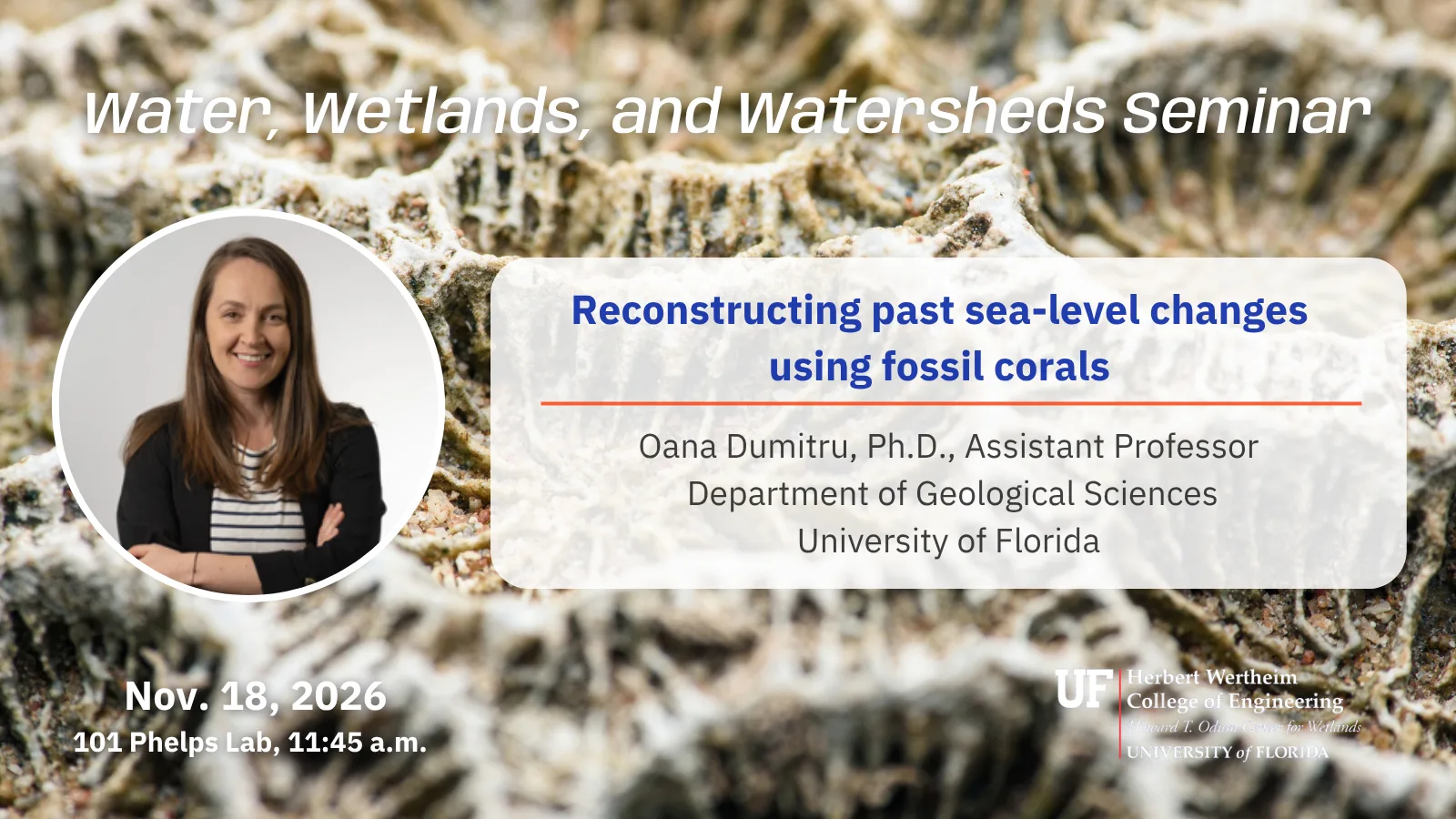
Oana Dumitru, Ph.D., Assistant Professor, Department of Geological Sciences, University of Florida
Join us for the livestream on November 18 at 11:45 a.m. ET: UF Howard T. Odum Center for Wetlands – YouTube
Abstract
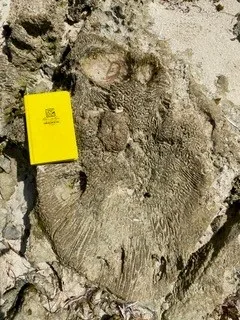
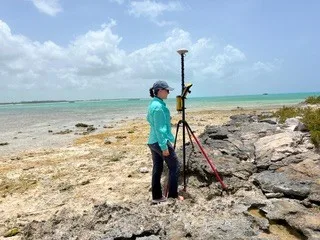
Future sea-level rise poses major threats to coastal ecosystems, communities, and infrastructure, but projections remain uncertain because we do not yet fully understand how the Greenland and Antarctic ice sheets respond to warming. Geological records from past warm periods help improve these projections. The Last Interglacial (~130,000-115,000 years ago) is particularly valuable because global temperatures were slightly warmer and global mean sea level was higher, providing a natural example of a warmer world. However, scientists still debate when sea level reached its peak, how high it rose, and how much of that rise was driven by ice-sheet melting. Estimates of peak global mean sea level range from less than 5 m to as much as 5-10 m above present, highlighting the need for better geological constraints. Fossil corals are valuable indicators of past sea level because they grew within relatively well-defined water-depth ranges and can be precisely dated using uranium-thorium methods. In this talk, I will present Last Interglacial sea-level reconstructions from in-situ fossil corals from several islands in the Caribbean. I combine uranium-thorium dating with careful screening for post-depositional alteration, field observations of stratigraphic context, accurate elevation measurements, and comparisons with modern reef habitats to estimate when and at what water depths the corals originally grew. These provide new constraints on Last Interglacial sea level and offer insights into how ice sheets responded to a warmer climate, information that can help us better understand the potential magnitude of future sea-level rise.
Biography
Oana-Alexandra Dumitru, Ph.D., is an assistant professor in the University of Florida’s Department of Geological Sciences. A geochemist and paleoclimatologist, she uses fossil corals and cave deposits to reconstruct past climate and sea-level changes, helping refine projections of future sea-level rise. She holds doctorates in geology from the University of South Florida and environmental science from Babeș-Bolyai University in Romania. Before joining UF in 2024, she was a postdoctoral fellow at Columbia University’s Lamont-Doherty Earth Observatory.